The Frustrating Truth About Fat Loss
You've been eating "clean." You've cut carbs. You've done cardio five times a week. You've tried intermittent fasting, meal prepping, and tracking macros in a notebook. And yet — the mirror looks exactly the same.
Maybe you lost 4 pounds, got excited, then watched them creep back on without changing anything. Maybe you've never even gotten that far.
Here's what nobody tells you: the problem usually isn't your effort. It's your information.
"Most people aren't failing at fat loss because they're lazy. They're failing because they're following advice designed for someone else's body."
Fat loss has been complicated by decades of conflicting research, predatory fitness marketing, and one-size-fits-all advice that ignores how different human bodies actually work. This guide cuts through all of that. We'll look at the real science-backed reasons fat loss fails — and then show you exactly what actually works.
What you'll learn in this guide
A research-driven breakdown of the 7 most common fat loss failure points — with practical fixes and how modern AI tools remove the guesswork entirely.
The 7 Real Reasons Fat Loss Fails
Before you try another diet, it helps to understand why the previous ones stopped working. Most failure points come down to these seven patterns — and once you see them clearly, they're all fixable.
1. You're eating more than you think
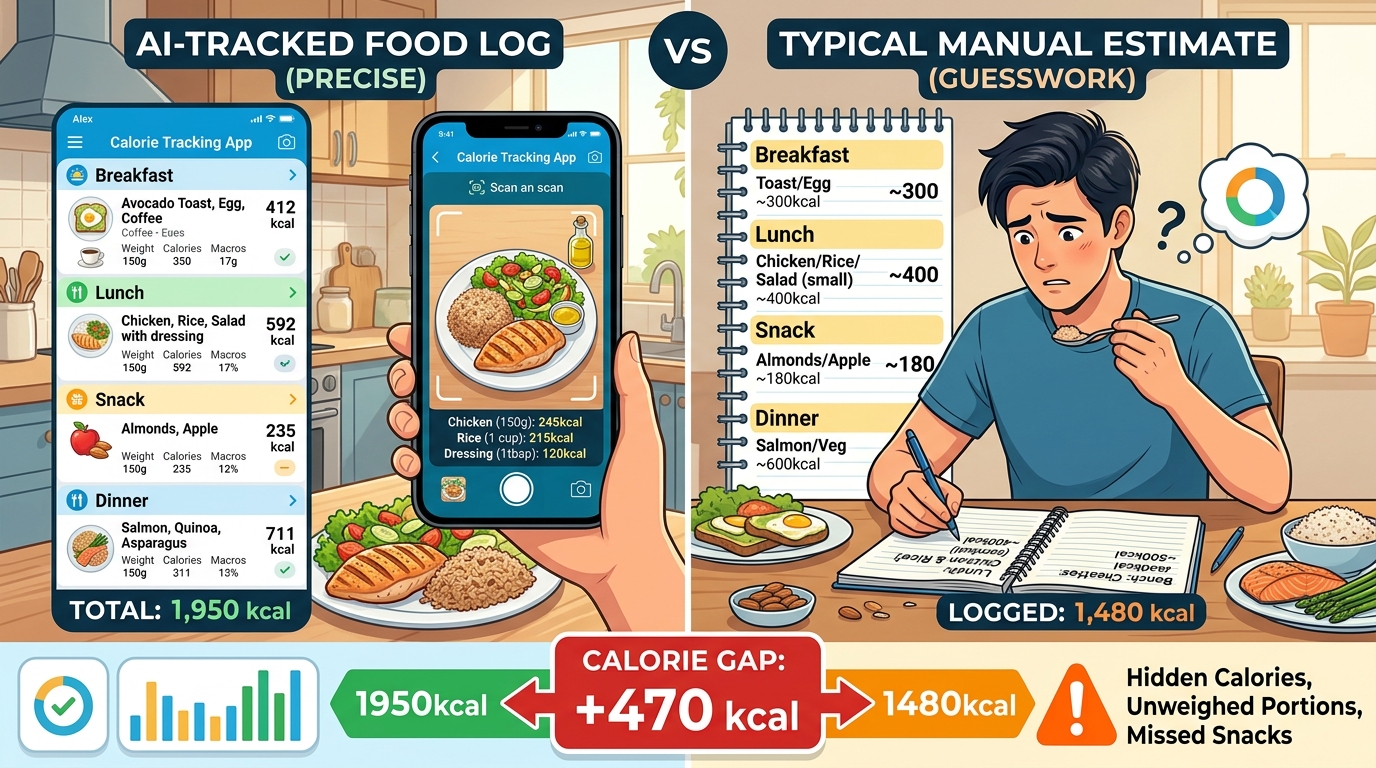
This one stings. Studies from the American Journal of Clinical Nutrition show that people consistently underestimate their calorie intake by 20–40%. A handful of almonds here. An extra pour of olive oil there. A "light" restaurant meal. These small gaps add up to hundreds of uncounted calories every day.
2. You're not eating enough
Yes — the opposite is also true. Many people drastically cut calories, lose some weight initially, and then crash. Eating too little triggers your body's starvation response, slows metabolism, and causes muscle loss. When you go back to normal eating (which you will), fat comes back faster than before.
3. Your plan has no personalization
A 28-year-old 5'10" man and a 44-year-old 5'4" woman have wildly different caloric needs, hormonal environments, and fat distribution patterns. Generic plans don't account for this. Most online diets are written for an average person — which means they fit almost nobody perfectly.
4. You're ignoring training quality
An hour on the treadmill feels like a lot. But low-intensity steady-state cardio is inefficient for fat loss compared to resistance training or HIIT. Muscle tissue burns calories at rest — building it is one of the highest-leverage things you can do for your metabolism long-term.
5. Stress and sleep are destroying your results
High cortisol (the stress hormone) directly promotes fat storage — especially around the belly. Poor sleep disrupts leptin and ghrelin, the hormones that control hunger. You can be in a calorie deficit on paper and still struggle to lose fat if your cortisol is chronically elevated.
6. You're not tracking consistently
Most people track for 3 days, then get busy, then stop. Fat loss requires sustained awareness. Inconsistent tracking is worse than no tracking — it gives you a false sense of control while the variables drift.
7. Your expectations are misaligned
Sustainable fat loss is 0.5–1 lb per week for most people. That's slow. But social media, transformation photos, and "6 weeks to a six-pack" programs have completely warped what's realistic. When people don't see dramatic results fast, they quit — even when they were making genuine progress.
Struggling to figure out exactly how many calories you actually need to lose fat? We break down the full science in our complete guide → Calorie Deficit for Fat Loss: The Complete 2026 Guide
The Calorie Myth That's Killing Your Progress
"Calories in, calories out" is technically correct — but dangerously oversimplified.
Yes, a calorie deficit is required for fat loss. No, not all calories behave the same way inside your body. 300 calories of chicken breast and 300 calories of a candy bar trigger completely different hormonal responses, different levels of satiety, different rates of digestion, and different muscle preservation outcomes.
The real issue with "CICO" isn't that it's wrong — it's that it ignores:
- Thermic effect of food: Protein burns more calories during digestion than fat or carbs
- Insulin response: High-glycemic foods spike insulin, which pauses fat burning
- Fiber and satiety: High-fiber foods reduce overall intake naturally
- Individual metabolism variation: BMR varies by up to 15% between people of identical size and weight
This is why two people can eat the exact same number of calories and have completely different fat loss outcomes. Bodies are not calculators. They're adaptive, hormonal, evolutionary systems.
Skinny Fat vs. Overweight: Why They Fail Differently
These two body types look different on the outside, but they share one thing in common: the same generic fat loss advice doesn't work well for either of them.
The skinny fat trap
If you're "skinny fat" — you look thin in clothes but feel soft, have low muscle definition, and carry fat mostly around your midsection — cutting calories alone will make things worse. You'll lose the little muscle you have and end up looking lighter but flabbier. The fix here isn't a calorie deficit. It's body recomposition: building muscle while gradually reducing fat.
The overweight approach
For those who are significantly overweight, the challenge is different: creating a sustainable deficit without triggering metabolic adaptation or muscle loss. Aggressive cuts work initially but always backfire. A moderate, well-structured deficit — paired with resistance training — is the only approach that works long-term.
Metabolism Myths People Still Believe in 2025
Metabolism has become one of the most misunderstood topics in fitness. Let's clear up the biggest myths that keep people spinning their wheels.
Myth: "My metabolism is just slow"
Research from the NIH shows that true metabolic disorders (like hypothyroidism) are actually rare — affecting about 5% of people. For most people, a "slow metabolism" is really just a combination of lower muscle mass, reduced NEAT (non-exercise activity thermogenesis), and underestimated caloric intake.
Myth: "Eating breakfast boosts your metabolism"
There is no credible evidence that eating breakfast meaningfully increases metabolic rate. This myth originated from breakfast cereal marketing in the 1990s. If breakfast works for you — great. If it doesn't, you're not missing a metabolic advantage.
Myth: "Eating multiple small meals keeps metabolism high"
Total daily calorie intake is what matters, not meal timing or frequency. Multiple studies have found no significant difference in fat loss between people eating 2 meals vs. 6 meals per day when total calories are matched.
Myth: "Cardio is the best way to burn fat"
Cardio burns calories during the session. Resistance training burns calories for hours afterward (the "afterburn" effect) AND builds muscle that raises your resting metabolic rate permanently. For sustainable fat loss, lifting beats running.
A 2022 meta-analysis published in the British Journal of Sports Medicine found that resistance training combined with a moderate calorie deficit produced significantly better long-term body composition outcomes than cardio-only approaches. View study →
How to Actually Fix Fat Loss (Step by Step)
Now for the practical stuff. Here's what actually works — built on current research, not trends.
Calculate your actual maintenance calories
Use your age, weight, height, and activity level to find your Total Daily Energy Expenditure (TDEE). Subtract 300–500 calories from this number to create your deficit. Anything more aggressive will backfire within weeks.
Prioritize protein at every meal
Aim for 0.7–1g of protein per pound of bodyweight daily. Protein is the most satiating macronutrient, has the highest thermic effect, and is essential for preserving muscle during a deficit. Without it, you'll lose weight — but it'll include muscle, not just fat.
Lift weights at least 3 times per week
Resistance training is non-negotiable for body recomposition. You don't need to become a powerlifter — even 3 focused sessions per week of compound movements (squats, deadlifts, rows, presses) will produce meaningful results.
Sleep 7–9 hours and manage stress
This isn't optional. Poor sleep raises cortisol, disrupts hunger hormones, and makes fat loss almost impossible even with a perfect diet. Prioritize sleep the same way you prioritize your workout.
Track accurately and consistently
Logging food daily — including everything — is the single biggest predictor of fat loss success according to a Kaiser Permanente study with 1,700 participants. People who tracked daily lost twice as much weight as those who didn't.
Reassess every 2–4 weeks
Your caloric needs change as you lose weight. A 200lb person needs different targets than a 185lb person. Recalculate every few weeks and adjust. This is where most people fall off — they set targets once and never revisit them.
How an AI Fat Loss Tool Solves All of This
If you look at those six steps above, there's a clear problem: they all require consistent, accurate, personalized tracking and adjustment. That's cognitively exhausting to do manually. And when we're tired, stressed, or busy — tracking is the first thing that goes out the window.
This is exactly the gap that AI fat loss tools are designed to fill.
The problem with manual tracking
Manual calorie tracking apps require you to weigh food, look up every item, enter portions correctly, adjust for cooking methods, and recalculate goals periodically. Most people do it enthusiastically for a week and then stop. Not because they're lazy — but because it's genuinely tedious and error-prone.
What an AI fat loss tool actually does
A well-designed AI fat loss tool removes these friction points by doing the analysis for you. Instead of entering numbers into a database and hoping they're right, the tool:
- Calculates your personalized TDEE based on real body data
- Adapts your targets as your weight, muscle, and activity level change
- Identifies patterns in your intake that you'd never spot manually
- Flags when your deficit is too aggressive or not aggressive enough
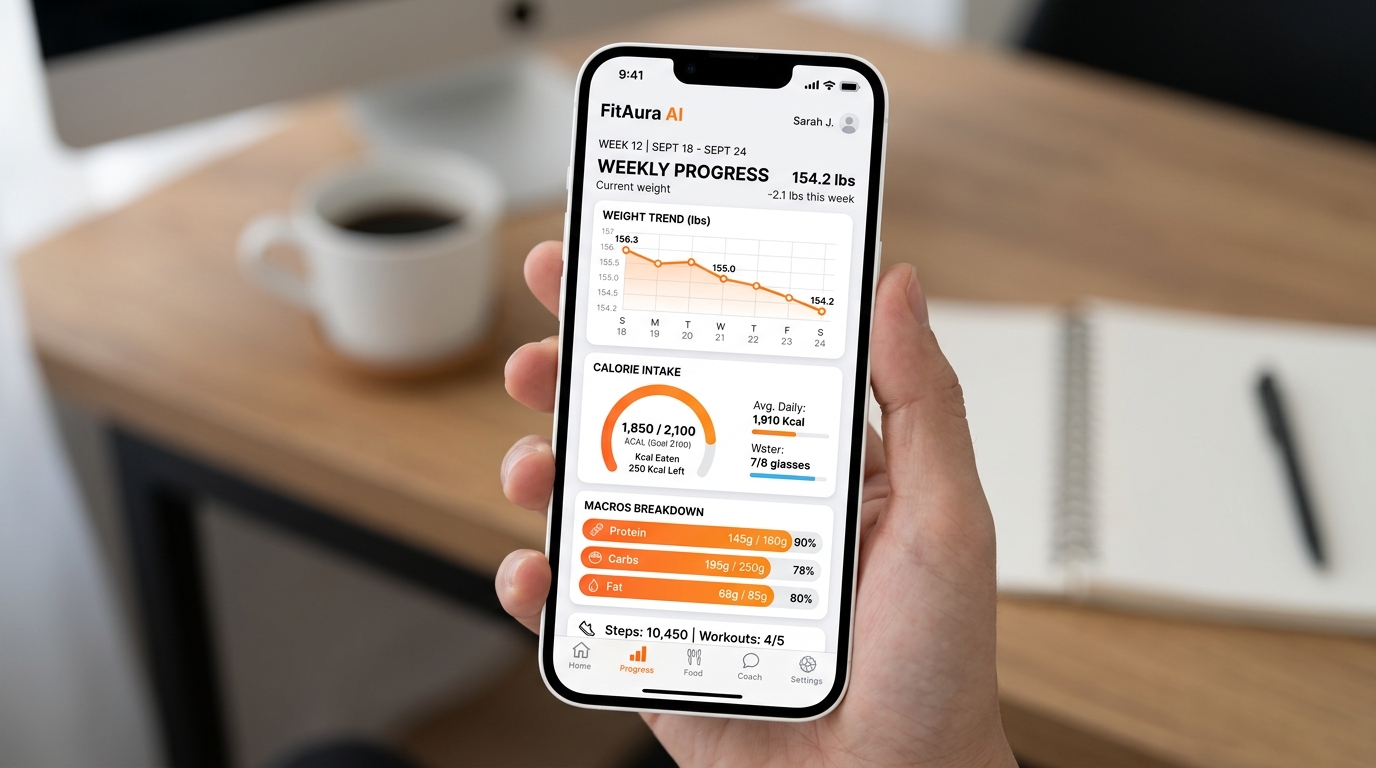
- Suggests adjustments based on your progress velocity — not a static formula
It's the difference between having a spreadsheet and having a coach who actually looks at your data.
Why personalization matters so much
Research from Stanford University found that personalized dietary interventions produced dramatically better outcomes than generalized ones — not because the calories were different, but because the approach matched the individual's actual patterns and biology. AI tools can deliver this kind of personalization at scale, for anyone, without requiring a nutritionist.
Stop Guessing. Start Losing.
Our AI fat loss tool builds a personalized calorie and macro plan based on your exact body data, adjusts it every week based on your real progress, and tells you exactly what's working — and what's not.
Frequently Asked Questions
The most common questions we get about fat loss, answered clearly.